When Kelley Turner and her husband founded Staycation Fiberglass Pools in 2022, they placed a high priority on picking out a project management software platform early.
Today, Turner has a stat that explains why.
“If you’re [using] spreadsheets, you’re probably leaving 8% to 12% on the margin,” says Turner, coowner of the San Antonio-based company.
She has watched it play out among builders who have switched from spreadsheets to a single construction management platform. Once they could document, line by line, what each pool actually required, their margins improved.
“A spreadsheet doesn’t give you what’s needed,” she says.
The distinction matters. Many of today’s pool companies still operate the way they always have, with a spreadsheet for the budget, a separate calendar for the schedule, and text messages flying back and forth with customers. Add to the mix a bunch of supplier invoices sitting in an email inbox and job photos buried on a project manager’s phone.
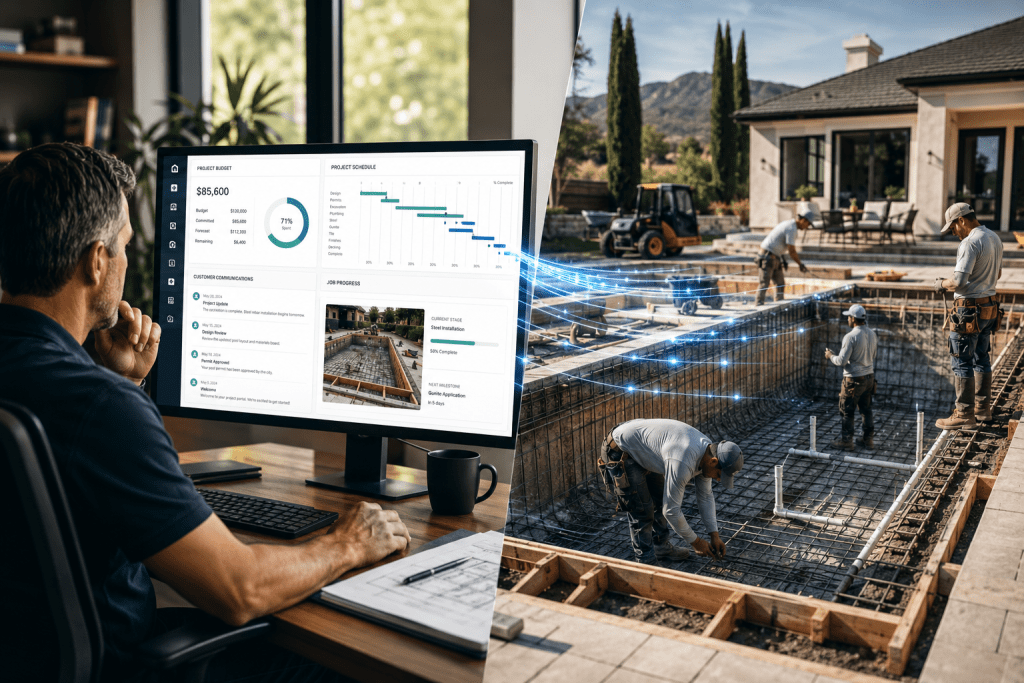
Construction management software pulls all this information and more into one platform. The estimate becomes the contract, which feeds the schedule, which tracks against the budget in real time for accuracy.
When a supplier delivers materials, the cost lands on the right job automatically. The customer can see progress photos and message the builder through the same system. By the time the pool is finished, the builder can see exactly what the project earned, line by line.
For a pool contractor, construction software is like a full-fledged team member — picking the right one matters as much as any new hire. Here, three tech-forward pool builders share what they looked for when deciding which platform to trust.
1. Is the pricing simple, transparent, and affordable?
Turner learned this lesson the hard way.
Before she finally found a platform that worked for Staycation, she spent eight months on one that didn’t.
“Eight months of hell,” she says. “Every time we tried to make a change, it was an increase in price.”
Software pricing in the construction space can get complicated fast. Many platforms run on tiered plans, where the basics sit at the entry level, but other key functions, such as customer support and the ability to add users, live two or three tiers up.
The lowest price simply gets you in the door with software that may not meet your needs.
A flat, affordable all-in price is worth more than a low entry rate that climbs every time you need to do something.
2. Does it have the features a business needs to operate efficiently?
Different builders have different priorities. For Jason Shanks, vice president of operations at Coastal Pools in Grasonville, Md., what mattered most was how fast his team could turn a customer conversation into an accurate bid.
A typical pool proposal at Coastal runs between 200 and 400 line items. Many pool builders, he says, take an old-school – and imprecise – approach to pricing materials — averaging the last 10 rebar invoices, dividing by square footage, and hoping it evens out across jobs. His current software changes that.
“With JobTread, you can have legitimate pricing line by line. You can pre-build out your groups. You can actually bid a pool in 10 minutes with legit accurate pricing down to the plumbing fittings,” Shanks says.
Coastal’s sales reps can now write a vinyl-liner replacement quote in the customer’s driveway before they leave.
For Turner, margin tracking at the job level ranked as the make-or-break feature. With supplier invoices flowing automatically to the right pool, the picture sharpens.
“Every single piece is going to be charged to that job,” she says. “So you really now know what your true margins are and where you’re spending.”
Of course, AI is reshaping the possibilities for construction software. Builders use it to pull data, build dashboards, and answer questions about their own jobs in ways that would have required a developer as recently as a year ago. (See the sidebar above.)
Whatever your priorities, list the features you need from a software before you start shopping, not after.
3. Does it connect to the other tools that your company uses?
For Liliana Escudero, co-founder of Los Angeles-based J Designs Pool & Spa, one feature mattered most when she chose her
current platform.
“That was the first thing that sold me, having an open API,” says Escudero, in reference to a platform that is built to connect
with outside tools. “It reduces my time just making double entries. That’s one thing that I hate the most — a double entry.”
Pool builders use a many different variations of softwareSome projectmanagement platforms connect easily to the rest of a company’s
tech stack while others leave the builder bolting on integrations through third-party services or building it themselves.
For Turner, a seamless integration with POOLCORP and Heritage means that every material charge flows automatically to the right pool, so her team doesn’t have to enter it by hand.
“The integration within JobTread has allowed us to not need as many employees to do jobs that would have had to be done manually,” Turner says.
“It’s allowed us to keep our profit.”
When you’re evaluating software, ask which of your current tools the platform connects to natively, and what happens when you need a connection it doesn’t already offer.
4. Does it put all your project information in one place?
For many pool builders, the information they need for one job lives in multiple places. Project photos, texts, and change order conversations scatter across team members’ devices and email inboxes every day.
Escudero knows the problem. For years, every customer conversation and job site issue at J Designs stayed in her husband JC’s head.
“It’s very difficult to run a business with limited information on projects,” she says.
Once that information moved into one place, she could see exactly where every job stood. “I can see at all times where my jobs are.”
At Coastal, Shanks has pushed his team to move conversations off text messages and into the platform, where everything is recorded.
“Everybody doesn’t always remember things the same way,” he says, so it’s good to have a record. “When you’re customer-service based, you’re always going to do the right thing for the customer. The builder tends to have to eat those things if he doesn’t have the documentation.”
5. How good is the training and support after you sign?
Every platform takes some learning. But how does the software company support you while you’re getting up to speed, and even after?
Escudero says builders should look for two things when evaluating support — training that you can do at your own pace, and a customer-service team that responds quickly if you’re stuck.
“You don’t need to answer my call immediately, but don’t make me wait two days to solve my problem,” Escudero says.
It’s also smart to make sure that the training and support are unlimited and included in one price.
You never know who on your team might need
assistance — or when.
6. Is the product still evolving?
In all likelihood, the software you sign up for today will not be the software you’re using in two years.
The question is whether the company is improving the platform constantly, or sitting on it until the next big overhaul. Shanks watched his previous platform sit unchanged for years before, finally, one single, massive took place. His current system is the opposite.
“They’re always making it better,” he says.
New features roll out regularly, and customers can submit requests directly. The best platforms release updates often and
listen to their customers.
7. Is there a strong user community behind the
platform to provide each other with support
over the long haul?
Beyond the help desk, the best platforms also come with a network of other users willing to share what they’ve learned.
The best user communities take work for the software company itself to manage. That means investing in Facebook groups, annual conferences, round tables, and other means for users to stay connected and share insights.
Turner and Escudero take part in a user group of eight to 12 pool builders who meet every month to compare budgets, share dashboards, and trade lessons on what’s working in their businesses, and what isn’t.
“Everybody has come up with their formulas that can help another builder,” Turner says.