
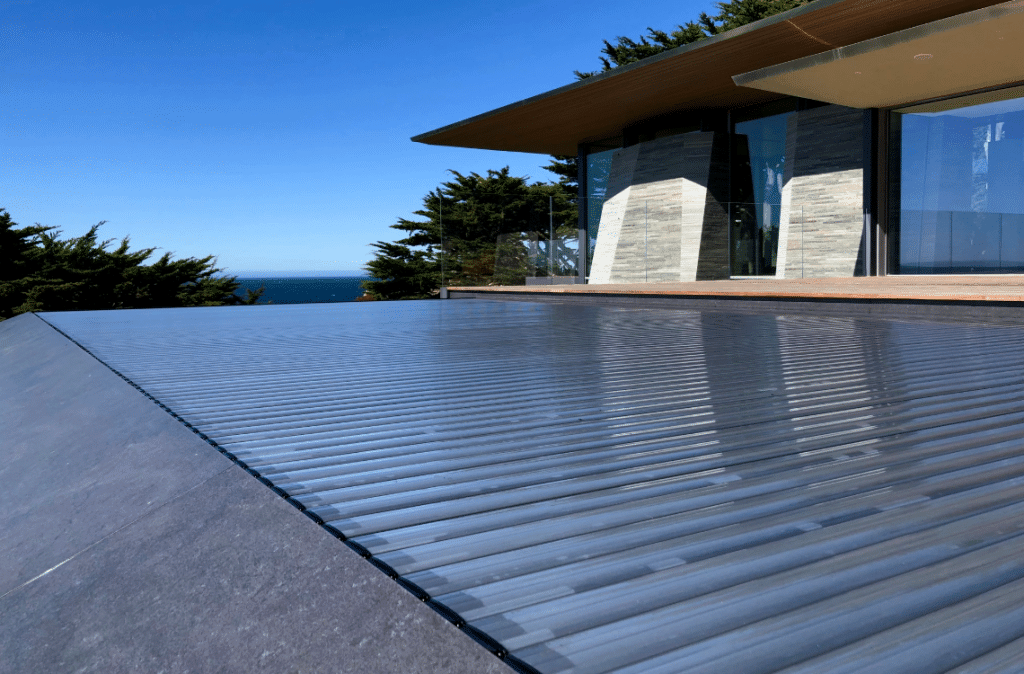
For high-end pool builders, architects, and aquatics engineers, the ultimate design challenge has long been a tradeoff: the grander the architectural vision, the harder it is to protect. When a client demands sweeping radii, vanishing edges, perimeter overflows, or sprawling multi-thousand-square-foot water shapes, traditional automatic pool covers have historically forced a compromise. Track-and-cable vinyl systems simply cannot bend around freeform curves or survive the mechanical stress of extreme scales.
Yet, as the aquatics industry navigates tightening energy codes, persistent droughts, and an explosion in custom pool geometries, compromising on sustainability and safety is no longer an option.
Aquamatic Cover Systems has been building automatic covers since 1980, and much of that work has gone into the installations standard track-and-cable systems cannot handle. Drawing on decades of hydraulic engineering and experience with complex residential and commercial installations, Aquamatic continues to bring automatic covers to increasingly ambitious pool designs.
Monumental Scale
In the world of pool covers, scale introduces immense physical forces—specifically, torque, friction, and material load. Aquamatic addressed these variables by abandoning electric clutches in favor of all-fluid hydraulics.
- The 4,000-Square-Foot Residential Pinnacle: Aquamatic recently engineered a massive 40-foot by 100-foot automatic system for a private coastal estate. Traditional vinyl covers are fundamentally limited at this scale due to limitations of the leading-edge bar and cover drum. Aquamatic bypassed these physics entirely by utilizing its trackless, rigid floating slat architecture, creating one of the largest residential automatic pool covers to date.
- The 8,535-Square-Foot Commercial Marvel: A community college aquatics center presented an irregular footprint combining a 95-foot competitive zone and a 65-foot recreational zone, separated by a structural concrete peninsula. Rather than attempting a single, impossible mechanical spool, Aquamatic engineered a synchronized, four-part automated system deploying from custom motorized benches. It shows how commercial facilities can achieve total evaporation control without sacrificing dynamic pool geometry.
The Trackless Revolution
While the flagship Hydramatic combines all-fluid hydraulic operation with certified safety-cover performance, the Hydralux trackless floating slat system gives architects greater freedom to integrate a cover into ambitious pool designs.
Because the Hydralux relies on extruded, rigid PVC or premium polycarbonate slats that float directly on the water’s surface, it completely eliminates the need for parallel side tracks. That single change opens up several design possibilities:
- Converging Layouts: The Hydralux can be custom-cut to match tapered or converging pool designs, allowing the cover to get progressively narrower as it deploys or retracts.
- Vanishing Edges and Radii: The precision-cut floating slats allow the pool to maintain its visual optical illusion when open, and total thermal efficiency when closed.
- In-Floor Submerged Recesses: For hyper-complex or circular shapes that cannot be covered from a traditional deck vault, Aquamatic integrates hidden in-floor wet wells. The cover silently emerges directly out of a flush, mechanical vault built into the pool floor, vanishing entirely from sight without requiring a single square foot of deck real estate.
High-Efficiency Solar and Smart Diagnostics
For an existing pool, adding an automatic cover can involve work well beyond the cover itself. Routing electrical power through finished decking or established landscaping can make an otherwise straightforward upgrade expensive and disruptive.
Aquamatic’s Solar Hydramatic addresses that installation challenge with a solar-charged battery that powers its hydraulic drive. The company has refined the charging setup, replacing an earlier four-panel configuration with a single upgraded panel.
Aquamatic has also integrated Bluetooth-enabled lithium-ion battery banks into the power pack. Builders and service technicians can pull real-time power metrics, battery health, and mechanical diagnostics from a smartphone, which turns a standalone mechanical accessory into a connected asset and gives homeowners off-grid reliability without disrupting the property.
The Return on Engineering
For the pool professional reading, the lesson of Aquamatic’s 46-year tenure is clear: engineering durability outlasts marketing trends. By utilizing closed-loop hydraulic drives and eliminating electromechanical clutch systems, Aquamatic backs its hydraulic system with a 20-year limited warranty.
As the industry moves deeper into an era focused on environmental compliance, structural complexity, and smart-home automation, the pool cover is no longer an afterthought. It is central to how efficiently a pool operates. Aquamatic isn’t just protecting pools.
They are helping builders bring a client’s dream pool to life without making the cover a compromise.
For more information, contact https://www.aquamatic.com/.