Pool and spa retail is still built on staples such as chemicals and accessories. But in many stores, those products are no longer the biggest story.
Across the industry, retailers are devoting more attention, showroom space, and merchandising effort to larger-ticket items
such as hot tubs, cold plunges, and saunas. The shift reflects several forces at once: changing consumer expectations, stronger profit margins in some categories, and a growing realization that retailers need to lean into the categories where their expertise matters most.
But selling and merchandising these products requires a different playbook.
Here, retailers explain how they’re creating environments that help customers imagine a better backyard and keep them coming back
for the products, guidance, and experience that online sellers and big-box stores cannot match.
Leaning into expertise
Before investing in new product categories, retailers should carefully consider if they’re equipped to sell the product well. Just because a product fits the backyard lifestyle doesn’t mean it always makes sense for a pool and spa store to offer it.
Consider grills. Some retailers are moving them off the showroom floor after finding that the category often delivers thin margins, faces heavy competition from big-box and chain retailers, and takes up valuable square footage that could be used for higherperforming
products.
“It was the lowest margin item in our showroom,” says Michael Panella, CEO of Swimming Pool Services in Waukesha, Wis. “It
got to the point where I’d rather have another hot tub on the floor.”
Likewise, Burton Pools & Spas, with locations across Arkansas, Oklahoma, and Missouri, cleared out its grill inventory to
emphasize products that support the company’s focus on health and wellness.
“Our knowledge was wasted on grills,” says Burton’s retail manager Rodney Porter. “That’s when we switched to a heavy focus on wellness.”
Retailers say the lesson is to lean harder into the categories where their expertise actually matters. Hot tubs, cold plunges, saunas, and semi-inground pools typically require a higher level of education and trust, along with a more consultative sales approach than do products customers can easily pick up at a chain store. That plays
more naturally to the strengths of a pool and spa retailer, where product knowledge, service, and long-term customer relationships are already part of the business.
Pool/spa store as a destination
As retailers shift toward more premium categories, they are also changing the function of the store itself.
Customers shopping for a hot tub or other large purchases are usually not wandering in on impulse. “They’re coming here on purpose,” says Burton Pools & Spas owner Caleb Burton. “They’ve done their research. They’re down the funnel a ways. On big-ticket items, they’re ready.”
Even so, many still arrive with incomplete or inaccurate information. Some are confused about issues such as saltwater systems or therapeutic light. That creates an opening for knowledgeable retailers to step in, clarify the facts and build trust.
“A lot of people have a great grasp of health benefits,” Porter says. “They come in here, we can give them even more information, and now they trust us with their $20,000 purchase.”
That dynamic has a ripple effect. Once a retailer becomes the trusted source for a large purchase, that relationship can strengthen retention and support future chemical and accessory sales as well.
Porter says Burton’s stores are highly focused on retention and on what he calls “creating our own customer base.”
Panella is seeing a similar pattern. At his store, cold plunges and saunas are drawing interest from customers who already own hot tubs, creating natural crossover opportunities. “We see a lot of folks
packaging those things together,” he says.
In that sense, the modern pool/spa store is becoming less of a convenience stop and more of a destination. Panella says his company’s off-the-beaten-path location actually works in its favor because customers seek it out intentionally. That kind of trip lends itself to a more considered purchase and gives the retailer more room to tell a larger story about the product, the lifestyle around it, and the accessories that round out the experience.
Merchandising matters more
If the product is more emotional, lifestyle-driven, and expensive, the
display has to do more work, says Anne Obarski, who has worked closely with the pool and spa industry through her firm, Merchandise Concepts. She says retailers cannot treat a hot tub, outdoor kitchen, or furniture grouping the way they treat a shelf of chemicals.
“You want to see, feel, touch, and so forth, whereas chemicals is a transaction,” she says.
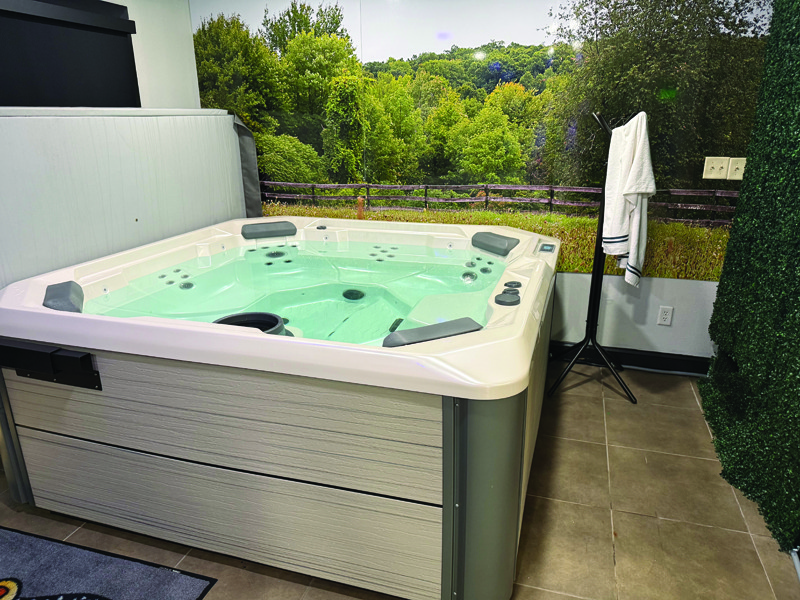
Obarski argues that the real challenge is not just carrying large-ticket items, but merchandising them well enough that customers can picture them in their own lives. A naked hot tub sitting on a showroom floor won’t cut it.
“You have to create a scene around the hot tub,” she says. “Will my life be better or different if I own one? That’s what customers are asking.”
In Burton Pools & Spas’ large Joplin, Mo. location, the challenge is making a large space feel more intimate and immersive, Porter says. To do that, the team builds environments around individual tubs,
breaks up sightlines, and uses TV screens showing outdoor scenery to create a sense of place. The store also has private soak rooms, including one with a cold plunge and sauna, designed to feel like a high-end spa.
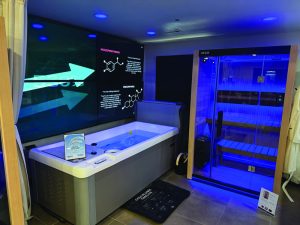
PHOTO COURTESY BURTON POOLS & SPAS
A compact showroom vignette features a cold plunge and adjacent sauna staged like a boutique spa, inviting customers to feel the wellness lifestyle rather than just view products. By merchandising high‑margin, big‑ticket amenities as immersive experiences, retailers turn floor space into a “ticket to profits” that builds trust and drives larger purchases.
Dennis Marunde, president of Arvidson Pools & Spas, says the same principle guides his company’s displays in the greater Chicagoland market. His showroom features product vignettes, including
multiple levels of terraces and decks that help customers visualize how a hot tub might look in their own backyard. That kind of staging becomes even more effective when paired with thoughtful lighting. Pathway lights, spotlights, and area-fill lights all help create different
moods throughout the showroom, Marunde explains, while a mix of cool, warm, and natural light can change how the space and product are perceived.
“Lighting and showroom color and floor patterns are hugely important,” Marunde says.
Panella also favors a cleaner, more controlled presentation. His showroom is intentionally spaced out so every product has room to breathe. He dislikes clutter around premium merchandise and believes pool toys and boxed impulse goods can undermine the feel of a high-value display.
“What I’ve been taught is you really shouldn’t have more than one day’s worth of product in your showroom,” he says. “We want to keep the showroom sleek and slim.”
For Obarski, that kind of discipline should extend to category testing as well. If a retailer is new to a category, she advises starting with a smaller assortment — perhaps three items in a good-better-best
structure rather than 12 scattered models. The goal is to learn what resonates without overcommitting square footage.
“Even if you only have three, do a very, very good job of that,” she says.
Strengthening sales
Retailers may be giving more room to large-ticket products, but that alone will not make the category work. The back end matters, too: marketing, training, ownership, and a willingness to measure each product’s performance to determine what actually works.
Premium categories require a stronger sales force and marketing plan than chemicals and similar staples. “There is good margin, but you have to promote it,” Burton says.
To support that, his company hired an inhouse marketing manager and expanded the marketing budget to support an omnichannel
strategy, including Over the Top (OTT) media, Facebook and Google ads. The firm has seen a strong return from the increased investment.
But it is not enough to rely on static displays, Porter says. Promotional messaging also matters. He credits one relatively new practice for moving his company’s inventory faster: displaying manager’s special offers on TV screens set behind the hot tubs.
“It makes a difference when you have ‘manager’s special’ on the TV screen and show the price from $15,000 to $12,000,” he says.
Retailers also need to take a strategic approach to staffing, Obarski says. Big-ticket categories require actual selling skills, not just product familiarity. Employees should be trained deeply on the merchandise, as well as how to build relationships and guide a larger purchase. She also recommends giving team members more ownership over a
category, including responsibility for merchandising, stocking, and sales performance.
In Obarski’s view, data has to play a larger role as well. Retailers should monitor turnover, markdowns, vendor performance, and square-foot productivity to understand whether a category deserves
more space or less.
Panella, while acknowledging the importance of hard metrics, also believes in the power of good old-fashioned observation. In his experience, a fresh set of eyes can reveal blind spots in product placement and customer flow that the owner may no longer notice. In his showroom, he wants customers to explore a bit, and for products to have enough visibility and awareness to prompt a sale.
That means displays cannot stay frozen. Panella’s staff revisits the stores’ merchandising at least monthly, especially in a seasonal market where what belongs on the floor in January largely differs from what belongs there in summer. Some items may need to come off the floor entirely at certain times of year, while others — such as hot tub accessories or sauna add-ons — deserve more attention.
Looking ahead, pool and spa retail is likely to become more interactive, lifestyle-driven, and dependent on expertise. As wellness continues to influence the category, showrooms will need to do more
than display product: They must house immersive, informative environments backed by stronger visuals, better-trained staff, and sharper use of data.
The throughline is clear: Pool and spa retailers are not just adding bigger products. They are rethinking the purpose and
mission of their stores.
The winning retail locations will still serve the customer who needs chemicals, water testing, or a quick replacement part. But they will also create environments where shoppers can imagine a better backyard, a stronger wellness routine, or a more complete outdoor lifestyle. In a market where consumers can find commoditized products on shelves everywhere, that advantage may matter the most.
“It’s all about the environment,” Burton says. “You need to create an
environment where people feel welcome — or they’ll go online.”