Vinyl-liner pools are being discussed in a different register than they were a decade ago. Instead of treating the liner as a laststep selection — pick a pattern, fill the pool, move on — homeowners often choose liners as part of an overall backyard composition, manufacturers say. The pool is expected to look intentional next to decking, hardscapes, and outdoor-living areas; it’s expected to photograph well; and to feel “finished,” not segmented by borders or obvious seams.
In discussing current liner trends, manufacturers point to several common themes: a swing toward deeper water colors and richer neutrals; fast-growing interest in borderless and allover prints; and a steady rise in specialty effects such as shimmer inks, iridescence, and embossing. Several sources also point to process improvements — printing, fabrication, and visualization tools — allowing for less obvious repetition, more refined seams and closures, and clearer ways to preview how a pattern will read once the pool is full.
The professionals quoted here refer to their own collections and technologies, but the universal takeaway for dealers and builders is straightforward: Liner selection is becoming a design decision on par with coping, decking, and furniture. The strongest sales process is the one that helps homeowners connect a liner choice to a finished backyard vision.
MOODY BLUES
The strongest consensus across sources is that blue is broadening in the direction of darker water and richer neutrals.
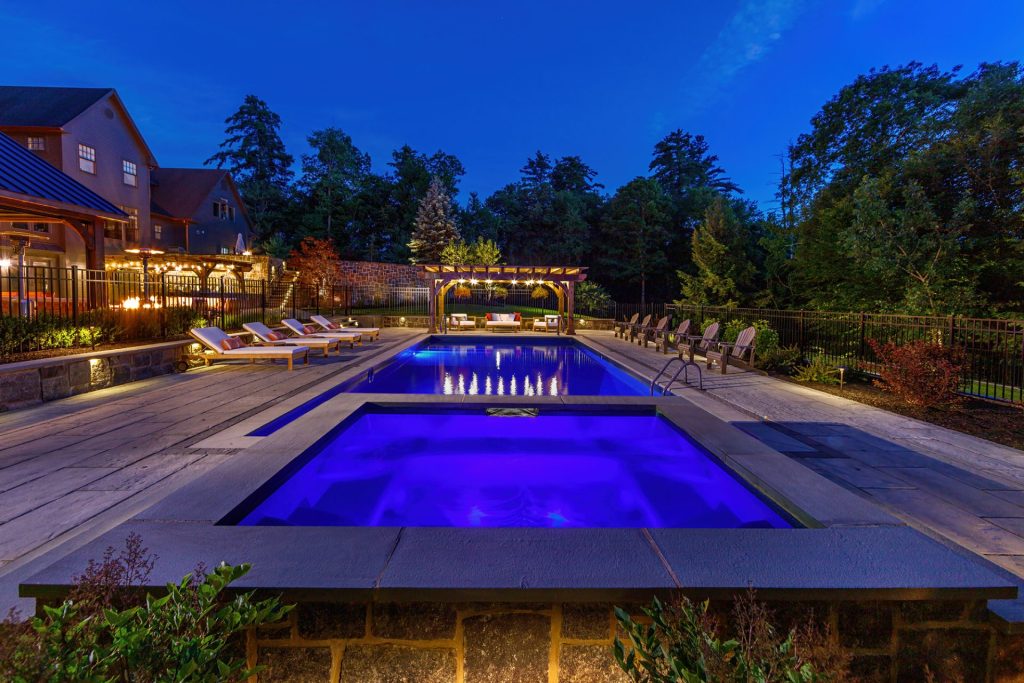
“Dark blue prints and earth-tone grays, in particular, continue to gain popularity,” says Will Cappiello, Latham Pools’ vice president of product management, vinyl liners and safety covers. “I believe this is driven by how homeowners now view their backyards as an extension of their living spaces. The pool becomes the focal point, almost like a piece of art. When paired with today’s earth-tone decking, hardscapes, and outdoor-living areas, a deep, rich blue or dark gray pool creates contrast, visual impact, and helps complete the overall look of a backyard oasis.”
While it’s true that the vinyl liner works in service of the overall design concept, homeowners want them to gain their due attention, says
Continental’s Livtec designer, Allison Gouterman. Blend in? Yes. Wallflower? No. “The designs that have thrived in this market possess an element of drama, capturing the attention of viewers,” Gouterman says. “These designs feature vivid colors and striking patterns that enhance the luxurious appearance of real tile, made even more impressive with vinyl.”
As homeowners push for richer water tones, builders are also weighing how well those tones will hold up visually over time.
“We have found that patterns with a darker base film have become more popular,” says Pegasus Pools’ Roshan Patel. “It maintains a
deeper, richer color even as it fades over time.”
Taken together, the comments suggest a practical way to talk about color with homeowners: Start with the backyard’s dominant tones (warm earths, cool grays, bright whites, lush greens), then decide whether the pool should contrast or blend. In that context, dark blues and
grays read as bold and architectural, while midblues and teals translate as lighter and more resort-like. But either can feel premium when the palette is intentional.
BORDERLESS PUSH
If color sets the mood, pattern layout increasingly signals whether a pool appears dated or contemporary.
On that front, sources are converging on the same prediction: Borderless and allover prints will continue to take more share.
“While they’re already growing in popularity, we haven’t yet seen a full market shift,” Cappiello says. “But it’s coming.”
Latham, for one, currently offers its largest selection of borderless patterns to date, Cappiello reports.
“Traditional tile borders that were popular 10 to 20 years ago are clearly phasing out,” he says. As he sees it, borderless patterns more
strongly hold their own against fiberglass and concrete finishes.
“When combined with the growing popularity of vinyl steps, it’s becoming increasingly difficult even for us to distinguish pool types when
customers send photos,” Cappiello says.
While uninterrupted pattern fields perform the high-end work in today’s backyard aesthetic and are expected to continue their upward trend, borders likely won’t disappear entirely, says Loop-Loc CEO LeeAnn Donaton.
“There will always be a border market, of course, and we have those too,” she says. “But contemporary pools look visually pleasing and
high-end if the pattern is continuous and uninterrupted. We never see a liner as a compromise over a gunite or fiberglass pool.”
Universally, the appeal is simple to explain in a showroom: fewer perimeter breaks, more consistent visuals, and a cleaner connection to
the outdoor living area.
SEAMLESS EXECUTION
This visual evolution comes courtesy of special effect inks and fabrication methods that make designs appear more seamless once installed.
“Trends are hand-in-hand with new technologies we see emerging from the vinyl mills,” Patel says. “New inks and methods of printing have made significant progress in the longevity of colors being used for designs.
“There has been great progress in creating patterns that appeal to broader audiences. New designs to catch your eyes using sparkling golds, to shining silvers, to bold iridescence to subtle pearlescence.”
For instance, shimmer inks have been around for only about seven years, and began to truly gain traction about five years ago, Gouterman says. “Shimmer inks really reign here,” she says.
Of Continental’s first gold shimmer pattern, Seaglass, which premiered in 2021, she says: “That has been and remains one of our most popular patterns to this day … Since then, we have added silver, metallic blue, and color-shift shimmer inks to our portfolio, featured in designs like Prism Cove and Starlight Swirl.”
She believes this effect process helps differentiate liners from other surface finishes: “We have seen that these incredible underwater effects
can create a heightened design, which is unique and unachievable outside of vinyl pool liner designs in the pool market,” she says.
Donaton credits special effects and surface textures with revitalizing the vinyl-liner market and advancing the design of these pools. Products featuring iridescent inks have proven steady sellers for the company.
“In recent years, we’ve seen iridescent inks add movement and tonal change to pool liners,” she says. “This is giving some cool themes, and I
believe we will see more of this in the future. Ink technologies are driving interesting outcomes in liner designs.”
And thanks to embossing, liners offer a more tactile experience, Donaton adds.
Producers also credit another, perhaps less glamorous, part of the fabrication process for adding to the category’s sophistication.
“In working with our fabricators, we have seen that the growth in heat welding has allowed for more complex designs and prints, as the heat
welding makes the pattern come together with a more seamless appearance, ” Gouterman says. “This has given us a lot of freedom on the design side to push what is possible in the vinyl pool market.”
SURFACE IMITATION
Another notable trend: Liners are competing visually with other pool types by referencing familiar “premium” surfaces — plaster, concrete,
tile, and stone — while still leaning into vinyl’s ability to do things those materials can’t.
“The prevalent trend has been to replicate the appearance of natural surfaces while adding a unique artistic flare,” says David Sones, the
design manager of industrial markets for CGT, which supplies vinyl to Garrett Liners.
He points to the company’s “Baia Aquasculpt” line, meant to create the look and feel of handcrafted Venetian plaster with sculpted
classical medallions through a combination of enhanced print and embossing.
“I think designers will continue to develop new ways to create a realistic look and feel in their designs,” he says.
Cappiello describes the same goal, while emphasizing that imitation is only part of the point: “We’re also focused on leveraging vinyl’s
unique printing capabilities — things that fiberglass and gunite simply can’t achieve,” he says. “… We take inspiration from natural
materials and broader design trends, then enhance them specifically for vinyl, pushing creativity while preserving beauty and realism.”
Water preview
As liners become more design-forward, the sales challenge is helping a customer picture the result once it’s installed and filled. In that
context, visualization tools are becoming part of the design and development process, not just a marketing add-on.
“The ability to create 3D renderings to assist in design presentations for new concepts allows designers to demonstrate to their customers
how each new design will look in the pool and in water before committing to developing the design,” Sones says.
For dealers and builders, the broader implication is that liner decisions are increasingly being framed around how the pool will read in water. Better preview tools help align expectations early and make it easier for customers to choose newer patterns with confidence.
In combination, these technologies have taken liners into a new era, these manufacturers say. “These more recent technologies redefined
and enhanced what a pool liner could be and opened a world of new design possibilities for the industry and for consumers,” Donaton says.
No doubt, future technologies will take the category even further, making liners an even more integral part of the design process, manufacturers predict.