By Tony Jordan, RENOLIT
Steel-wall pools have long been a staple of the residential market. They are economical, quick to install, and widely distributed across North America. But as these pools age, many homeowners face the same reality: fading interiors, dated aesthetics, and surfaces that no longer perform as they once did.
In many cases, however, the underlying steel wall structure remains sound. The challenge is not structural failure, but surface deterioration.
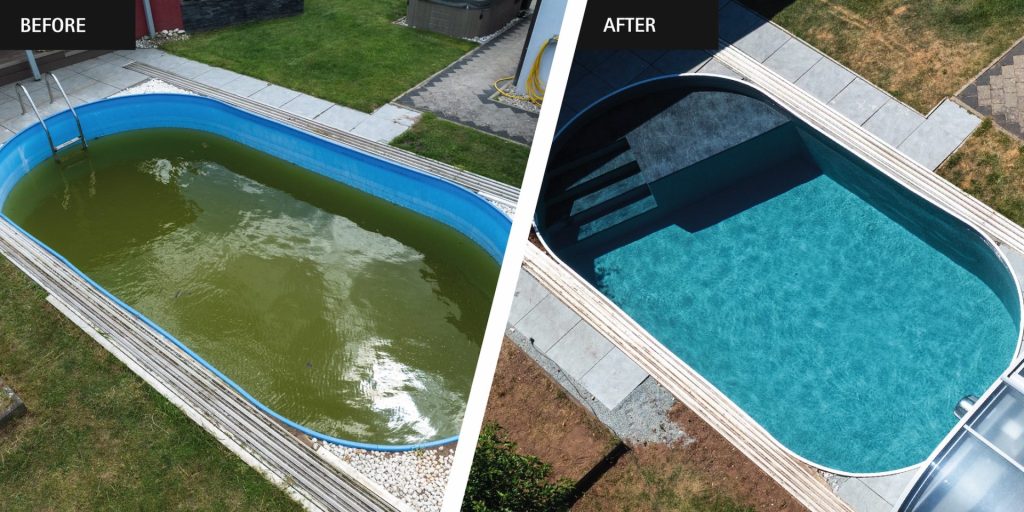
That reality is reshaping how contractors approach renovation. Rather than pursuing full demolition and reconstruction, contractors are increasingly evaluating reinforced PVC membrane systems as a renovation strategy that preserves the existing shell while upgrading waterproofing performance and visual appeal, while reducing project scope, cost, and disruption to homeowners.
From liner replacement to system upgrade
For decades, updating a steel-wall pool typically meant replacing a 20-30mil vinyl liners. While effective in the short term, that approach rarely improved durability or expanded design flexibility.
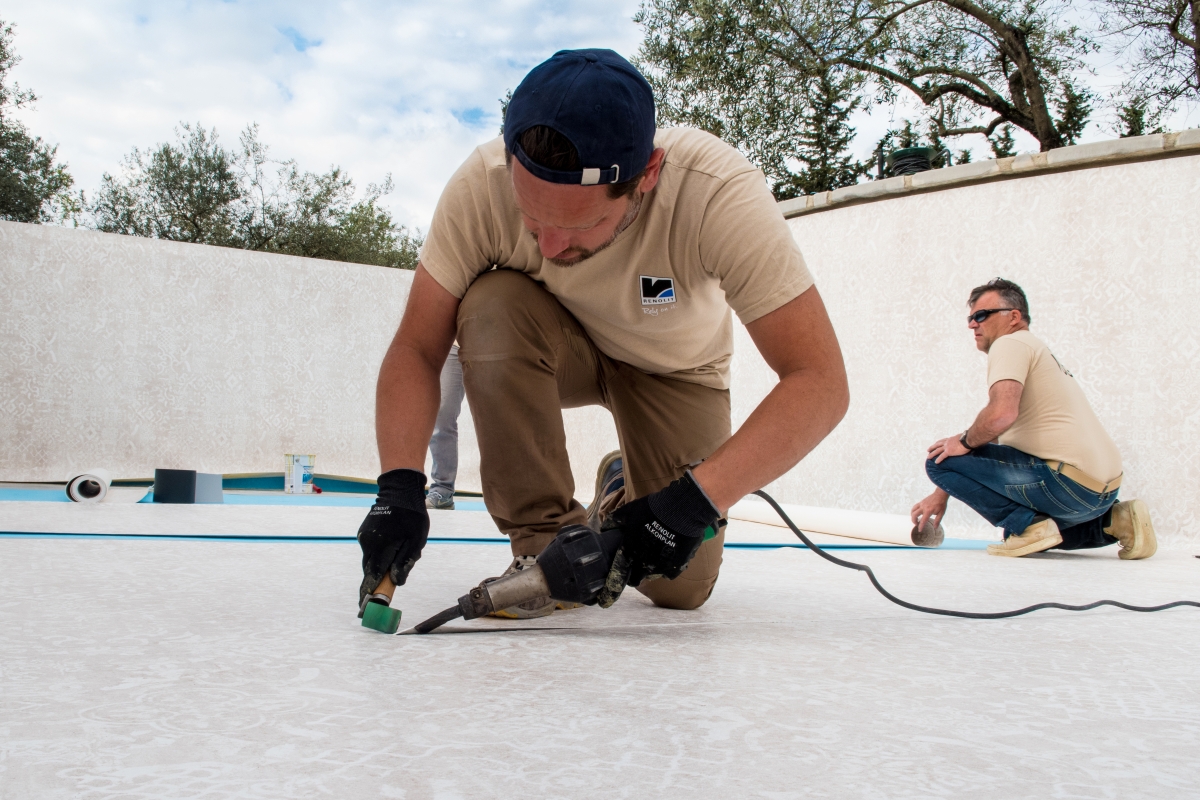
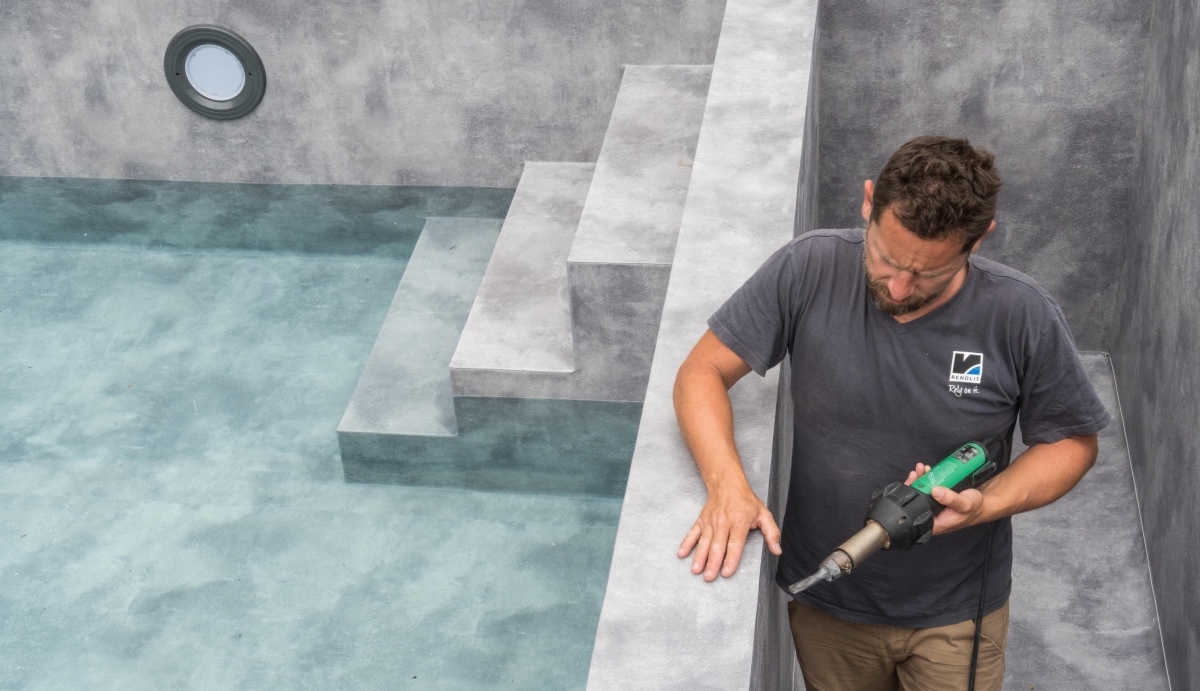
Reinforced PVC membranes represent a fundamentally different category. Constructed as a multi-layer composite with an internal polyester reinforcement grid, these membranes are typically 60 to 80 mil thick — roughly two to three times thicker than a standard 20–30 mil vinyl liner. The embedded polyester mesh controls dimensional movement and enhances mechanical stability, while thermally welded seams create a monolithic, watertight surface. Rather than functioning as a loose interior finish, the membrane becomes a fully integrated waterproofing layer designed for long-term performance.
This distinction is particularly relevant in renovation projects where the objective is to extend service life rather than simply refresh appearance.
Modern design expectations
Homeowners today expect more than a basic blue interior. They are looking for materials that elevate the backyard environment.
Reinforced membranes are available in a broad range of colors and textured finishes that replicate stone, slate, or contemporary architectural tones. Textured surfaces can also provide slip-resistant performance on steps and shallow areas, blending aesthetics with practical safety.
Renovation also allows contractors to rethink interior features. Integrated steps, benches, or lounging areas can be added during the upgrade, repositioning an older steel-wall pool as a modern design centerpiece rather than a dated installation.
In addition, because seams are butt-welded and lie flat, finished installations present a uniform surface appearance, with weld lines far less visible than overlapping liner seams.
Built for today’s chemical reality
Water chemistry in residential pools has evolved. Higher sanitizer levels, extended operating seasons, and greater UV exposure all increase stress on interior surfaces.
Reinforced PVC membranes are engineered to resist chlorine exposure, UV degradation, and microbial growth. Because seams are thermally welded, the system maintains consistent watertight performance even under freeze-thaw conditions.
For service professionals, that durability can translate into fewer callbacks related to cracking, delamination, or surface deterioration.
Many reinforced membrane systems also carry long-term waterproofing coverage — commonly backed by a 15-year warranty and available up to 20 years — providing added confidence for both contractor and homeowner.
Performance longevity not only reduces service issues, it also changes the long-term lifecycle equation for the pool.
Sustainability through preservation
There is also a sustainability dimension to this renovation strategy.
Retaining the existing shell significantly reduces material waste compared to demolition and reconstruction. Extending the service life of an installed asset lowers the overall environmental impact of the pool over time.
In this context, durability becomes a form of sustainability. The longer a surface performs reliably, the fewer resources are required for repair or replacement.
A growing opportunity
Across North America, a large installed base of steel-wall pools is now reaching the age where interior updates are inevitable. Homeowners want modern aesthetics, improved durability, and long-term value.
For builders and service companies, reinforced PVC renovation represents more than a technical solution — it is a business opportunity. By offering a performance-driven alternative to simple liner replacement, professionals can differentiate themselves in an increasingly competitive market.
Steel-wall pools were never intended to be disposable. With the right renovation strategy, they can deliver decades of additional performance and visual appeal.
Instead of replacing the pool, upgrade it.
About the author:
Tony Jordan has more than 35 years of experience in the manufacturing, sales, and application of polyvinyl chloride (PVC) reinforced pool membranes for commercial and residential use. He is the business development manager at RENOLIT and can be reached at tony.jordan@renolit.com. For more information, visit www.renolit-alkorplan.com