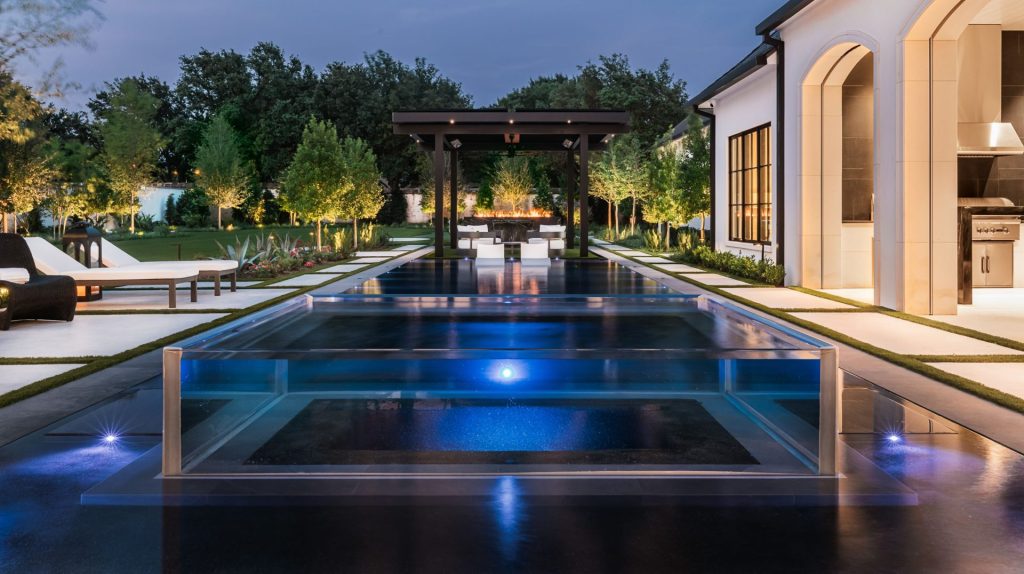
The sleek appeal of a see-through panel cannot be replicated.
Whether recessed in a pool wall or floor as a window or serving as a vanishing-edge wall, these features can present a dramatic ice-block-like appearance at night that especially makes sense at a time when contemporary design tends to dominate.
In the vast majority of cases, acrylic will be chosen for these designs, as the material proves more workable and retains its clarity over time. Still, these features boost a project’s complexity exponentially. Consider these factors when including acrylic panels in your pool, spa or waterfeature.
Consult an engineer and the manufacturer: When joining acrylic with concrete, leaks become a critical concern.
Manufacturers and engineers should weigh in regarding the best caulks, grouts and waterproofing agents for the application. In addition, engineers should be consulted to help create a structure that properly supports the panel, in part by transferring loads from the panel to the surrounding structure.
They often will require more steel reinforcement, higher-strength concrete mixes, and thicker shells than normal. They may also recommend poured-in-place concrete in certain areas.
Expansion, contraction and rotation: Being softer than concrete, acrylic panels will expand and contract more than concrete.
To account for this differential in expansion and contraction rates, installers should use flexible grouts and waterproofing agents. (Of course, always follow manufacturer recommendations.)
Expansion, contraction and movement become a particular concern when acrylic panels serve as a vanishing-edge wall. For one thing, expansion and contract affects the wall’s height: Since it’s not supported on the top, it will grow higher in heat and dip down in the cold. This means the hydraulic system needs to allow some flexibility, so the flow can adjust with wall height. Make sure the appropriate person knows how to adjust during temperature extremes. Also build more water-in-transit than you normally would into the system.
Because they lack the support of concrete encasement on the top, acrylic panels also have an increased risk of rotating. For this reason, they’ll need to be placed in a deeper slot in the floor and packed with a non-shrink grout.
The view inside: The view that these panels allow into the pool certain provides a sense of novelty. However, especially in the case of thicker panels, the acrylic can act as a magnifying glass, calling attention to every bit of dirt in the water or craftmanship error on the interior finish.
To make the view as crystal-clear and flattering as possible, take measures to ensure clean water and create as flawless a finish as possible. You can boost filtration, choosing methods that remove smaller particulate. Work with subcontractors to minimize flaws and irregularities in the surface.
And always take special care with the joint between the panel and shell, concealing caulking and setting materials as much as possible. Some builders paint the panels where it makes contact with the concrete.
If all else fails, place the panel where people can only look in from farther away.